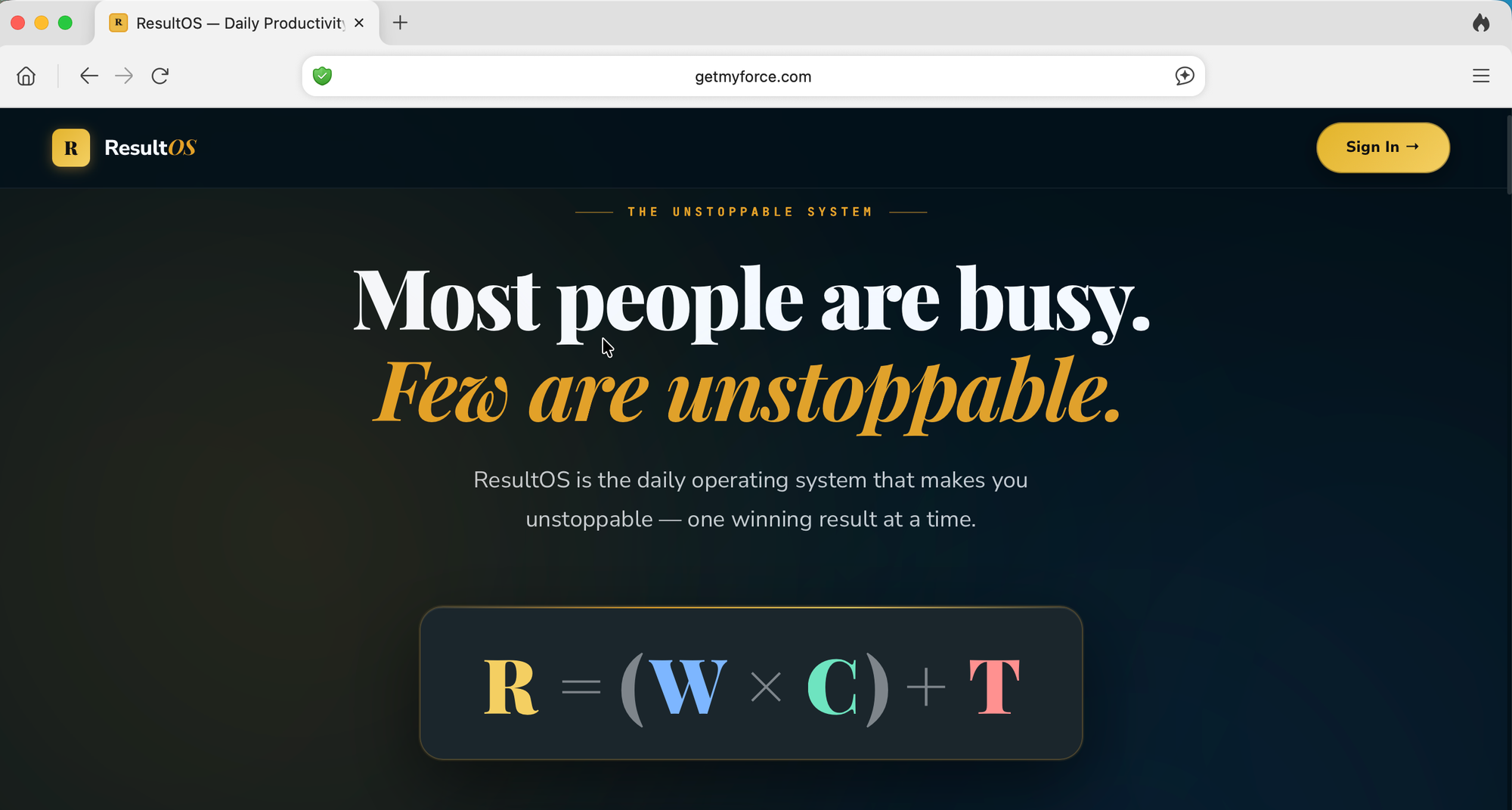
Most people are busy. Few are unstoppable.
ResultOS is the daily operating system that makes you unstoppable — one winning result at a time.


ResultOS is The Unstoppable System — built for people who ship the right result every single day. It starts with the result, protects deep work, and reviews performance honestly.

Origin of ResultOS:
Here's the intellectual lineage of ResultOS — how each thinker's core idea maps to the system:
Napoleon Hill — Burning desire
Hill spent 20 years interviewing 500 of the most successful people of his era — industrialists, inventors, politicians, writers — looking for the single factor that separated those who achieved from those who didn't. His finding, published in Think and Grow Rich, was not what most people expect. It wasn't discipline. It wasn't talent. It wasn't even hard work. It was desire. Specifically, a burning, obsessive desire for a definite outcome — the kind that makes a person show up on day 47 of something, when the novelty is completely gone and the discomfort is fully present.
Hill distinguished desire sharply from a wish or a preference. A wish is passive. A preference is conditional. Desire, in Hill's framework, is the thing that reorganises your behaviour even when you don't feel like it. It's not something you manufacture with willpower — it's something you discover about what you genuinely want badly enough to endure honest execution every single day.
In ResultOS, burning desire sits above the equation. It is not a variable — it's the reason the equation runs at all. Your W, your focus blocks, your honest end-of-day scoring — none of it sustains without the fire underneath. That's why it lives at the top of your Monthly Results Area, always visible, always first. Before you define what you're doing today, you need to remember why you care enough to do it honestly.
Brian Tracy — The W variable
Tracy spent decades studying why some people achieve dramatically more than others with the same 24 hours. His conclusion was deceptively simple: the highest performers identify their single most important task and complete it before doing anything else. He called it "eating the frog" — the idea that if the first thing you do each morning is the hardest, most impactful task, everything else feels easier by comparison.
What most people miss about Tracy's work is that it's not about willpower. It's about sequence. The decision of what comes first is the decision that shapes the entire day.
In ResultOS, this became the W — one winning result, defined with enough clarity that you could hand it to someone else and they'd know exactly what done looks like. The morning ritual doesn't ask "what are your tasks today?" It asks "what is the ONE result that makes today a win?" That's pure Tracy.
Elon Musk — The equation itself
Musk's contribution to ResultOS isn't about hustle or working 100-hour weeks. It's about first principles decomposition — the practice of breaking a complex problem down to its irreducible components rather than reasoning by analogy. Most productivity systems are built by analogy: "successful people wake up at 5am, journal, meditate, exercise, then work." That's copying the surface pattern without understanding the physics underneath.
First principles asks: what actually produces a result on any given day? Strip away every habit, ritual, and framework — what's left? You need to know what you're doing (W), you need to concentrate on it without fragmentation (C), and you need to spend the remaining time in a way that sustains you (T). That's it.
R = (W × C) + T isn't a motivational formula. It's a decomposition. And because W and C are multiplied, not added, the equation reveals something most systems hide: a perfectly clear goal with zero concentration produces zero. Deep focus on the wrong goal also produces zero. You need both. The multiplicative structure is the insight.
Charlie Munger — The three character checks and honest scoring
Munger was Warren Buffett's partner for over 60 years and arguably the sharper thinker of the two. His most powerful idea wasn't about investing — it was about thinking itself. Two principles shaped ResultOS directly.
First: inversion. Munger said most people ask "how do I succeed?" — the wrong question. The right question is "what would guarantee failure, and how do I avoid that?" We applied this to the equation. Instead of asking "what behaviors lead to high R scores?" we asked "what makes each variable go to zero?" W goes to zero when you pick a decoy goal (self-deception). C goes to zero when attention fragments (no pre-commitment). The feedback loop breaks when you score dishonestly (ego protection). Each of the three character checks — Brutal Honesty, Decisive Protection, Discomfort as Signal — exists to prevent one specific failure mode. They're not aspirational virtues. They're structural safeguards derived from inversion.
Second: honest feedback loops. Munger was obsessed with self-deception as the root of bad decisions. The "Did the W ship?" binary in Close the Loop is a Munger principle — it doesn't ask how you feel about the day, it asks whether the outcome happened. Yes or no. No negotiation. The entire scoring system is designed to make self-deception structurally difficult, because Munger understood that a system fed with dishonest data will produce confident wrong answers — worse than no system at all.
Tony Robbins — The T variable and energy management
Robbins is often dismissed as a motivational speaker, but his core insight is physiological, not psychological: your state determines your performance, and your state is driven by how you manage your body and energy, not just your mind.
Most productivity systems treat the human as a cognitive machine — set the right goals, manage your time, execute the plan. Robbins argues that none of this works if your energy is depleted, your body is neglected, and your emotional state is negative. You can have a perfect W and protect your focus blocks, but if you skipped meals, didn't move, and ignored sleep, tomorrow's W × C will collapse.
The T variable in ResultOS captures this. It's the additive bonus — health, learning, rest, movement, secondary wins. It asks "beyond your primary W, how well did you spend today's time?" A day with a high W × C but a T of 1 means you shipped the work but burned the fuel. That's not sustainable. Robbins would say the T variable is what makes the system survivable across months, not just impressive for a week.
How they blend together

The power of ResultOS isn't any single idea — it's the synthesis. Tracy tells you what to focus on. Musk's first principles give you the structure to think about performance. Munger's inversion tells you what to avoid and keeps the system honest. Robbins ensures the system is sustainable by accounting for the human behind the equation.
Most productivity tools cherry-pick from one school of thought.
ResultOS takes the one non-negotiable principle from each thinker — the principle they'd each say matters more than everything else they've ever taught — and wires them together into a single daily operating system.
The equation R = (W × C) + T is where these four minds converge.
Give 30 days to yourself, to learn the threads of ResultOS. This ResultOS is FREE forever. ( For first few days, it will be difficult as you will be breaking old patterns and your mind will push back. Just continue, do not overthink)

-Prasad